

MBUS Smart Heating Balance Valve
Product Overview
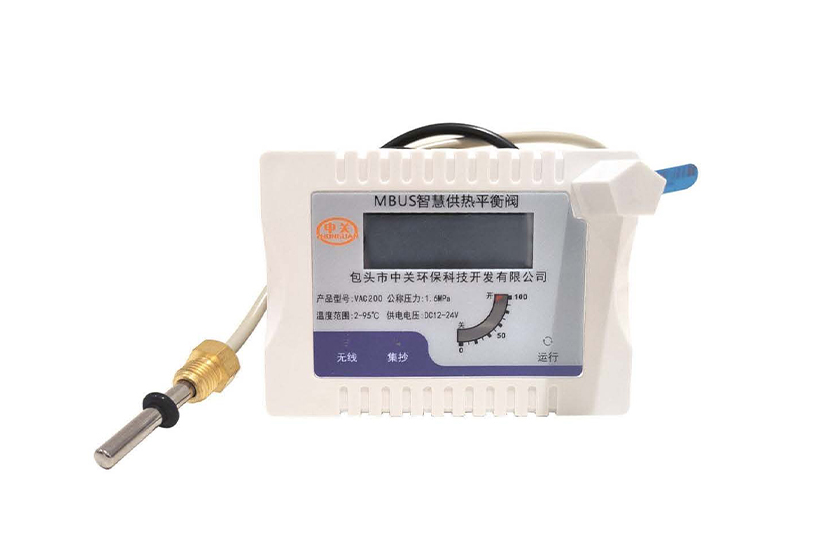
The MBUS Household Smart Heating Balance Valve is a smart regulating valve specifically designed for HVAC applications. This regulating valve aims to control return water temperature and valve opening position. It can also communicate with intelligent heat network balancing systems through its built-in network module to achieve valve regulation and accomplish household-level thermal balance.
Features and Functions
① Battery-powered with optional external power supply.
② Actuator and regulating valve are integrated in one unit to prevent unauthorized disassembly by users.
③ Flexible PT1000 options: single temperature measurement, dual temperature measurement, or no temperature measurement.
④ Screen display supports both rotation mode and magnet-touch switching, flexibly selectable.
⑤ Supports three remote control modes: opening degree adjustment, return temperature regulation, and temperature difference regulation, with free switching between modes.
⑥ Supports multiple transmission modes with remote modification of collection and upload cycles, server IP, and supports breakpoint resume transmission.
⑦ Data reporting employs random offset reporting strategy to prevent network congestion.
⑧ Local active wake-up and debugging can be performed via mobile phone Bluetooth + infrared module.
FAQ
QHow does the MBUS Household Smart Heating Balance Valve achieve household-level thermal balance?
AIt focuses on return water temperature control and valve opening regulation as core objectives, supporting three control modes that can be switched as needed: remote opening degree adjustment, return temperature regulation, and temperature difference regulation. The valve has a built-in network module that can communicate with intelligent heat network balancing systems to enable remote regulation and coordinated control. When necessary, local active wake-up and debugging can also be performed via Bluetooth + infrared.
QWhat power supply and installation options are available for the valve, and what impact do they have on operation and maintenance?
AThe device supports battery power supply and can also use external power supply, facilitating deployment under different site conditions. The actuator and regulating valve adopt an integrated installation design, which reduces operational risks caused by unauthorized disassembly or modification. On the operation and maintenance side, more suitable power supply solutions can be selected based on site power conditions and maintenance cycles, reducing the frequency of on-site interventions.
QWhat communication and data reporting capabilities are supported, and how are network risks reduced?
AIt supports multiple transmission modes, allowing remote modification of collection and upload cycles, server IP, and supports breakpoint resume transmission to improve availability in unstable link scenarios. Data reporting employs a random offset reporting strategy to reduce network congestion risks caused by concentrated reporting. During on-site debugging, mobile phone Bluetooth + infrared modules can be used for local wake-up and parameter adjustment, reducing the cost of repeated site visits.
