

On-Off Time Area Method Solution

The On-Off Time Area Method heat metering and allocation system is designed in accordance with the JGT 379-2012 "Technical Conditions for On-Off Time Area Method Heat Metering Devices" standard requirements. It calculates the user's nominal heat consumption based on total heat quantity, user heating area, and heating time—an advanced and practical technical solution.
The On-Off Time Area Method heating metering solution reduces both investment and operating costs while allowing users to autonomously regulate indoor temperature according to actual heating needs, thereby saving heating expenses. The solution also provides a management platform capable of real-time dynamic monitoring of heating conditions, enabling relevant departments to grasp system operation and user heating status more promptly and effectively, so as to deliver more efficient heating services.
Product Components:
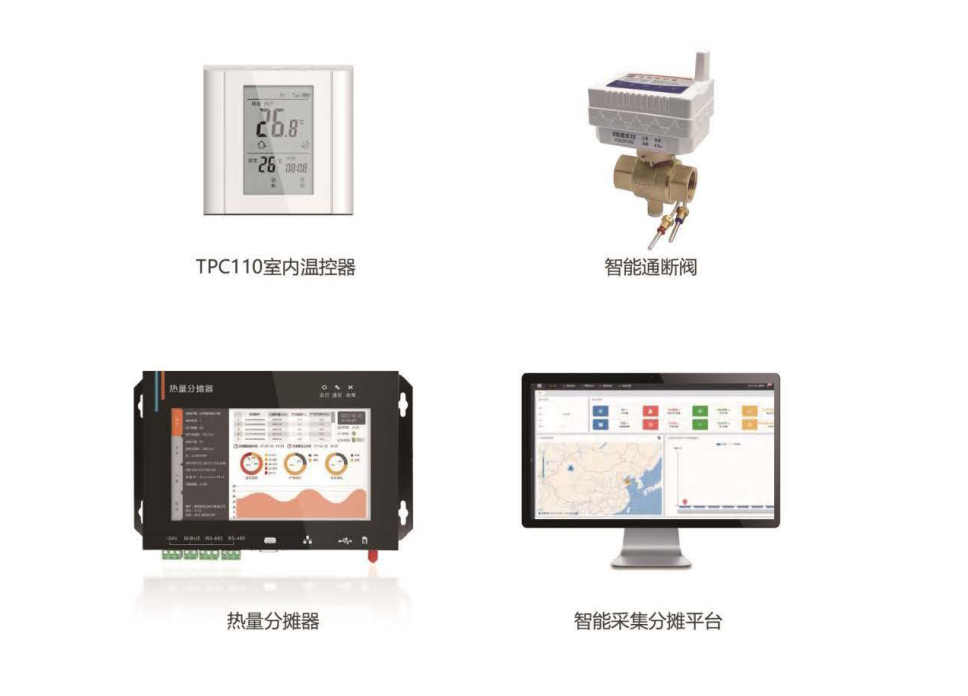
Key Features and Advantages
① The heat allocator supports multiple allocation modes including heat meter series connection, heat meter parallel connection, and virtual master meter.
② The heat allocation algorithm incorporates multiple allocation coefficients, balancing fairness and the interests of heat supply companies.
③ The on-off controller includes supply and return water temperature measurement, correcting allocation data based on supply and return water temperature.
④ The on-off controller is available in a modulating type that performs hydraulic balancing based on return water temperature.
Applicable Market Types
This solution integrates both heat metering and user temperature control devices. Its overall project cost is lower than integrated temperature control metering, making it suitable for renovation of old buildings.
FAQ
QHow does the On-Off Time Area Method heat metering allocation system calculate user heat consumption and perform allocation?
AThe system uses total heat quantity as the basis, combined with each household's heating area and actual heating time, to calculate the user's nominal heat consumption for cost allocation. The heat allocator supports heat meter series connection, parallel connection, and virtual master meter modes to accommodate different station structures. The allocation algorithm can configure multiple allocation coefficients to balance fairness and operational demands.
QWhat core equipment comprises this solution, and what problems does each address?
ACore components include the heat allocator, on-off controller, and management platform for real-time monitoring. The heat allocator is responsible for connecting heat meters and completing allocation calculations in different modes. The on-off controller includes supply and return water temperature measurement, enabling temperature difference correction of allocation data; when equipped with the modulating type, it can also perform hydraulic balancing based on return water temperature. The management platform dynamically monitors heating status and user heating conditions to enhance operational response efficiency.
QWhat project scenarios is the On-Off Time Area Method solution suitable for, and what are the key considerations when selecting?
AThis solution integrates heat metering and user temperature control needs with an overall project cost lower than integrated temperature control metering, making it suitable for cost-sensitive scenarios such as old building renovation. When selecting, first clarify the heat meter connection method and on-site pipe network structure to match series connection, parallel connection, or virtual master meter allocation modes. Simultaneously assess whether a modulating on-off controller is needed for hydraulic balancing, as well as the scope of platform-side requirements for real-time monitoring and operation and maintenance management.
